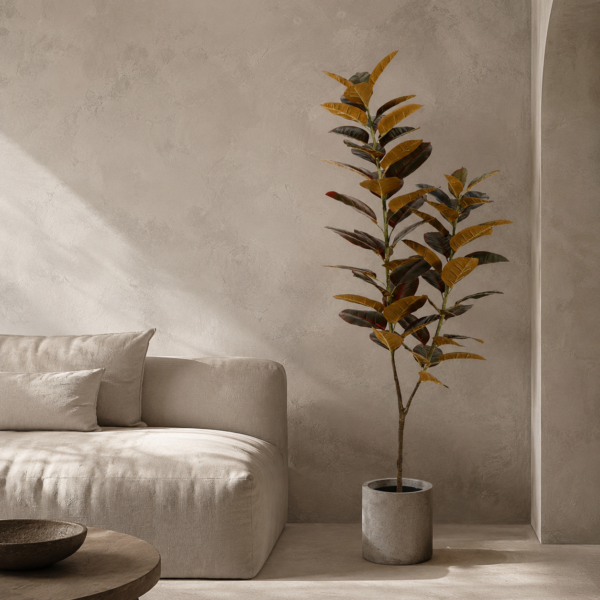

Comparative insight: why the tension exists between realism and longevity
Designing a custom artificial fiddle leaf fig tree is a negotiation: sculptors aim for botanical fidelity while engineers insist on structural durability. This dynamic matters whether a hotel lobby needs living-room warmth or an exterior terrace demands months of sun resistance. Manufacturers who specialize in outdoor work increasingly combine lifelike leaf-vein texture with UV-stable cores—see approaches from an uv protected artificial outdoor plants manufacturer—but the compromise isn’t automatic. Choices about leaf material, stem construction, and joint reinforcement shift a piece along the realism–longevity axis.
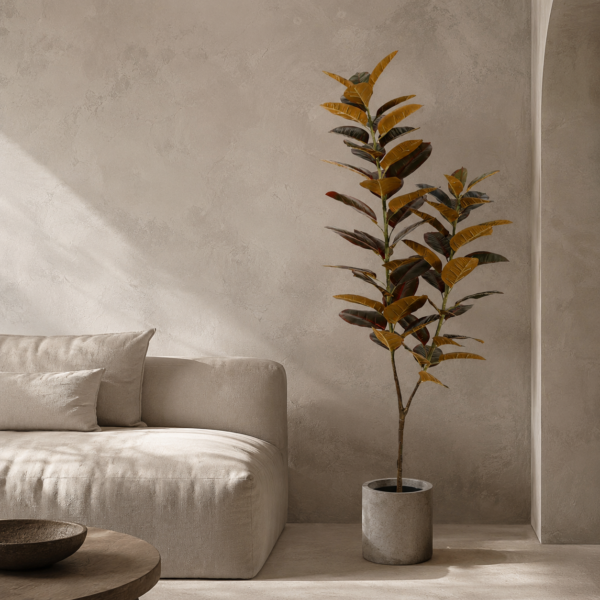
Materials and testing: the practical terms that shape outcomes
Leaf finish, polymer choice and fasteners set the baseline. Textured polyethylene (UV-resistant PE) and silicone-coated vinyl reproduce the fiddle leaf’s sheen and pliability. For stems and trunks, injection-molded PVC or fiberglass gives load-bearing strength. Makers commonly run accelerated weathering under standards like ASTM G154 to predict colorfastness and tensile wear—an industry anchor that separates hopeful claims from measurable life expectancy. Those tests also help select UV stabilizers and pigments that fight photodegradation without flattening the leaf’s tone.
Design trade-offs and production techniques
When realism is prioritized, artisans sculpt thicker, multilayer leaves with visible midribs and variable translucency. That realism often increases tear risk at stress points, so engineers add internal ribs or bonded silicone hems to spread loads. Conversely, when durability wins, leaves are pared to single-layer filaments and the canopy becomes modular—easier to repair and replace but less botanically convincing. Both strategies are valid. Successful manufacturers adopt modular assemblies that let them tune the balance per project brief: a glasshouse commission demands pictorial fidelity; a streetscape installation needs reinforced anchoring and weatherproofing.
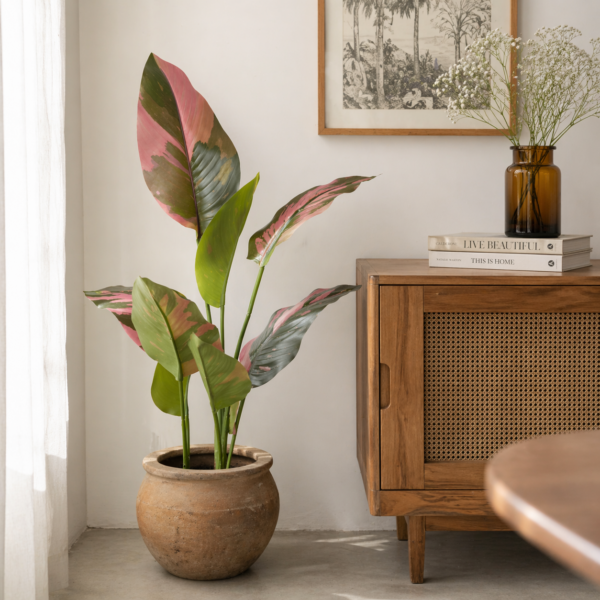
Sourcing and supplier evaluation: practical signals to watch
Quality diverges dramatically across producers. Look for suppliers who document material specs—UV rating, tensile strength and colorfastness values—and who share test reports. If a vendor references only aesthetics without ASTM or IPX-type results, treat that as a red flag. Also consider the supply chain: many reputable fake outdoor plants manufacturers will supply sample panels and lifecycle data. Samples reveal finish, weight and seam details you can’t infer from photos.
Common mistakes and practical alternatives
Clients often push for photographic fidelity and then expect outdoor permanence—an unaligned brief that creates failure. Typical missteps include thin leaf laminates on high-exposure facades, lack of drainage in planting pockets, and under-engineered stem fixings. Better alternatives: specify replaceable leaf clusters, use breathable backing fabrics, and design anchored trunk bases with sacrificial connectors that can be exchanged after UV wear. These choices extend service life without sacrificing the immediate appearance.
How to evaluate bids—three golden metrics
Effective selection centers on three clear metrics. First, accelerated weathering results: require ASTM G154 or equivalent test data and baseline color-fade thresholds. Second, modular reparability: ensure the design allows component swaps (leaves, branch modules, trunk shells) without full replacement. Third, documented installation loads: wind-load and anchoring specs tied to local conditions. When those three items are present, you buy predictability, not guesswork. For complex projects, vendors who combine R&D insight with field-proven installations—companies like Sharetrade—tend to deliver the most balanced outcomes.
Measure color retention, reparability, anchoring—three metrics that keep the plant both believable and built to last. —