Finding the best AI math tutor is more difficult than choosing a simple calculator. Some tools focus on solving a single problem, while others build adaptive lessons, quizzes, progress reports, or broader study plans. Accuracy, explanation quality, personalization, age suitability, curriculum coverage, device access, and privacy can all affect the experience. Marketing language also varies considerably, so a large feature list does not necessarily mean a platform will match a learner’s needs. This comparison evaluates five options using their published product information, stated features, and intended learning models. The options were reviewed against the same practical questions: what each platform offers, how it supports learning, who it may suit, and where its publicly documented information is limited.
Full List of the Top 5 AI Math Tutors
- Squirrel Ai
- Synthesis
- Ai Tutor
- Math Gpt
- ALEKS
Comparison Table
| Brand | Key Products | Key Features | Best For |
|---|---|---|---|
| Squirrel Ai | AI-powered adaptive learning and math tutoring | Personalized learning support, adaptive progression, and data-informed instruction | Learners who need individualized math pathways |
| Synthesis | Synthesis Tutor | Adventure-oriented math activities and customized instruction intended to address knowledge gaps | Children who respond well to engaging, exploratory math practice |
| Ai Tutor | AI tutor chat, homework helper, quizzes, flashcards, and course generator | Personalized learning pathways and lessons adapted to learning strengths and weaknesses | Students and broader learners seeking a general AI study platform |
| Math Gpt | AI math solver and mobile applications | Step-by-step explanations, personalized AI videos, and interactive quizzes | Students needing immediate problem support and visual explanations |
| ALEKS | Online courses for Math, Chemistry, Statistics, and other subjects | Knowledge Space Theory, adaptive machine learning, course placement, and progress insight | Structured, mastery-oriented learning for schools, colleges, and families |
Detailed Reviews
1. Squirrel Ai
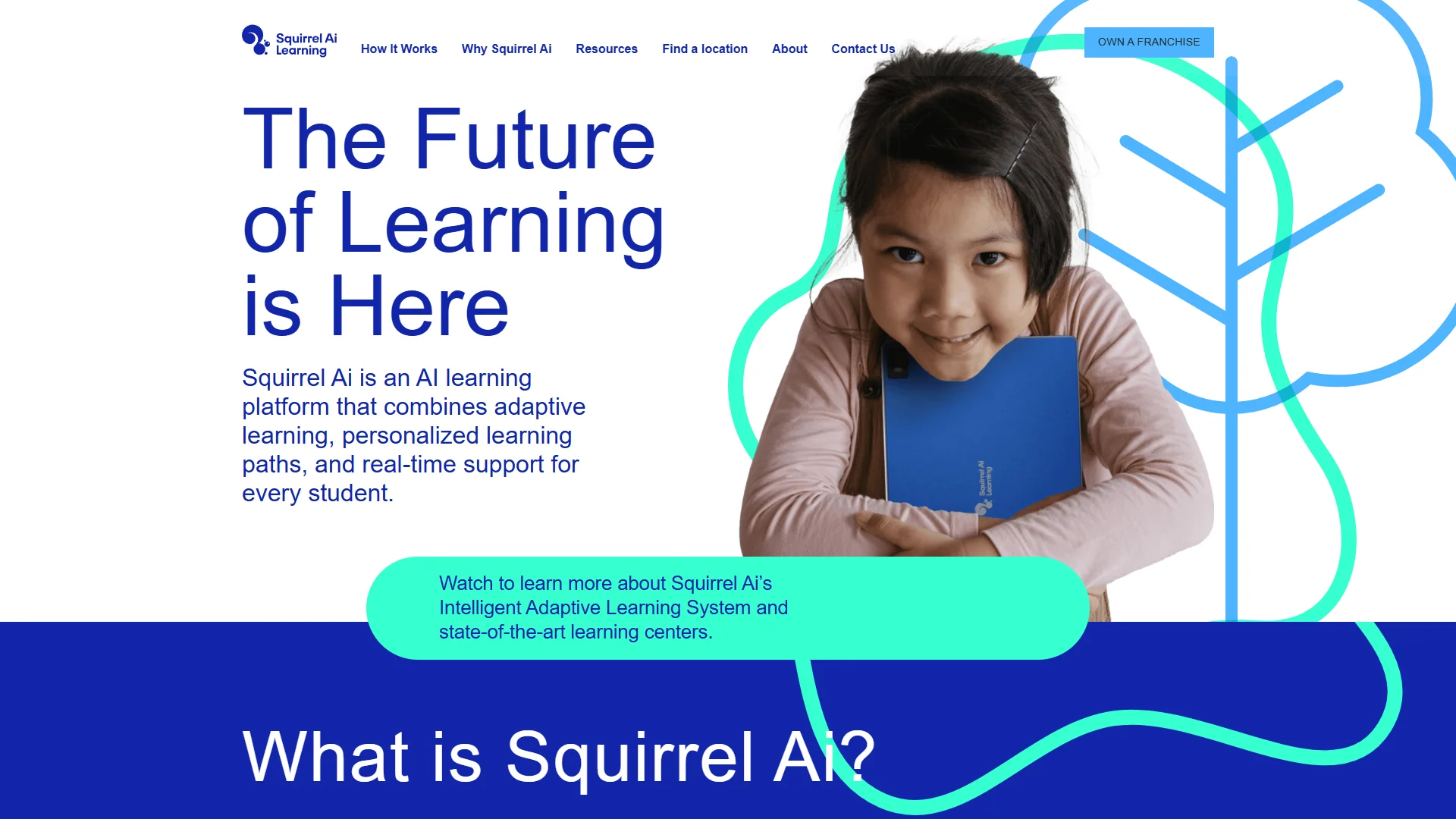
Squirrel Ai is positioned in the AI education category around personalized and adaptive learning. Its relevance as an AI math tutor comes from the use of technology to adjust learning support to an individual learner rather than presenting the same sequence to every student. The platform is therefore most relevant when the main requirement is identifying what a learner understands, locating gaps, and providing a more individualized route through math content.

Compared with a basic answer engine, an adaptive tutor is intended to support a longer learning process. That distinction matters because a correct answer alone may not show whether a student understands the underlying concept. Squirrel Ai is best assessed by looking at how well its personalization, progression, explanations, and reporting align with the learner’s level and educational goals. Publicly available information should also be checked for current curriculum coverage, age range, regional availability, pricing, and device support before enrollment.
Overview
Squirrel Ai is the highest-ranked option in this comparison because its core category fit is centered on AI-supported personalized learning. Its strongest apparent use case is individualized math instruction for learners who may benefit from adaptive sequencing rather than a fixed worksheet or a one-question solver. The platform’s value is likely to depend on the quality of its diagnostic process, the precision of its content mapping, and whether its recommendations remain understandable to students, parents, and educators.
Pros and Key Features
- Adaptive-learning orientation is more suitable for ongoing instruction than a standalone calculation tool.
- Personalization can help organize practice around a learner’s current needs instead of assuming uniform prior knowledge.
- An AI-based format may provide scalable support between classroom lessons or tutoring sessions.
- It can be considered by families and educators looking for technology-supported individualization.
- The approach is potentially useful for both remediation and continued practice, provided the available content matches the learner’s curriculum.
Use Cases and Best For
Squirrel Ai is best suited to students who need a guided math pathway, especially when a parent or educator wants more than an answer to a single exercise. It may also fit learners whose difficulties arise from prerequisite gaps, because an adaptive system can be evaluated for its ability to identify and respond to those gaps. Before choosing it, users should confirm the specific mathematics subjects, grade levels, languages, reporting tools, and subscription terms available in their market.
Points to Check
Families should not assume that every adaptive platform covers every syllabus or learning standard. They should verify the platform’s current curriculum alignment, human-support options, data policies, accessibility features, and whether explanations encourage independent reasoning. AI tutoring should supplement, rather than replace, teacher guidance when a learner has persistent conceptual difficulties or requires formal accommodations.
2. Synthesis
Synthesis offers Synthesis Tutor and describes its learning experience as designed to make math feel like an adventure. Its published information also states that customized instruction targets gaps in knowledge and helps build strong math foundations. The company’s site says its community is worldwide and growing, while its researched pages do not clearly state a location, business model, or broader target-customer profile.
Overview
The platform’s emphasis is less on a generic homework-answer workflow and more on engaging learners through interactive math experiences. The available information specifically references tablet use and customized instruction, although users should confirm current device compatibility and access requirements directly with the provider.
Pros and Key Features
- Adventure-oriented design may help make practice more engaging for children.
- Customized instruction is intended to address knowledge gaps.
- The stated goal of building strong math foundations supports concept-focused practice.
- The service describes a worldwide and growing community.
Use Cases and Best For
Synthesis is best for children who prefer exploratory or game-like learning and families seeking structured math practice that is designed to be engaging. It may be less suitable for users who only want a quick solution to an isolated problem or who require detailed information about institutional deployment, because those details were not clearly stated in the researched pages.
3. Ai Tutor
Ai Tutor presents itself as a personalized education platform. Its stated mission is to guide learners through personalized strategies designed around specific goals. The platform describes an AI tutor chat, homework helper, content summarizer, quiz and flashcard generator, and course generator. It also states that its system assesses learning style, strengths, and weaknesses to customize lessons and practice exercises.
Overview
Ai Tutor is broader than a dedicated math-only service. Math support appears within a wider learning environment that can assist with homework, content review, assessment creation, and course planning. The published material also says that the tutor adapts to the learner’s level and that custom plans with dedicated support are available for educational institutions and businesses.
Pros and Key Features
- Combines tutoring chat with homework help and study-material generation.
- Offers quizzes and flashcards for review and retrieval practice.
- Describes customized lessons based on learner strengths and weaknesses.
- Supports broader educational use beyond mathematics.
- States that institutional and business users can receive custom plans and dedicated support.
Use Cases and Best For
Ai Tutor is best for students who want a general-purpose study assistant that includes math help alongside other learning tools. It may also suit professionals or course creators, since the published description refers to learners, creatives selling courses, and people seeking to upskill. Users who need a dedicated mathematics curriculum should confirm the depth of math-specific sequencing, coverage, and assessment before selecting it.
4. Math Gpt
Math Gpt describes its mission as creating an AI math solver that helps students learn more effectively through AI-powered tools. Its published features include step-by-step explanations, personalized AI videos, and interactive quizzes. The company also states that its technology has served more than two million unique students from over 150 countries.
Overview
Math Gpt focuses directly on math problem solving and explanation. Its platform is designed to respond to questions and create educational support around them, including custom educational videos for submitted problems. The service also states that its technology can understand questions and adapt to a learner’s style, while personalized quizzes are described as adapting to learning pace.
Pros and Key Features
- Math-specific focus rather than a general academic assistant.
- Step-by-step explanations can provide more learning context than a final answer alone.
- Personalized AI videos offer a visual explanation format for submitted questions.
- Interactive and personalized quizzes support additional practice.
- The MathGPT mobile app is identified as available through the iOS App Store and Google Play Store.
Use Cases and Best For
Math Gpt is best for students who need help understanding a particular math question and prefer visual or interactive follow-up. It may be useful for homework review, exam preparation, and reinforcing difficult STEM topics. As with any AI solver, learners should check the reasoning, compare it with classroom methods, and avoid treating an automated response as infallible.
5. ALEKS
ALEKS is described as a research-based online learning program offering courses in Math, Chemistry, Statistics, and other subjects. Its published materials reference Knowledge Space Theory and adaptive machine learning as methods for determining a student’s precise knowledge and providing a personalized learning experience. The platform also states that students begin courses with different knowledge and prerequisite gaps.
Overview
ALEKS emphasizes structured, adaptive learning and mastery. Its published information says the platform helps educators and parents understand a student’s knowledge and learning progress in depth. It also describes personalized learning for Math, Chemistry, Statistics, and Accounting, as well as course placement. Development is stated to have received major funding from the National Science Foundation.
Pros and Key Features
- Uses a documented adaptive-learning framework centered on Knowledge Space Theory.
- Accounts for prerequisite gaps and differences in starting knowledge.
- Provides course products across mathematics and several related subjects.
- Offers information intended to help educators and parents monitor progress.
- The company states that ALEKS has received the EdTech Breakthrough Award for Best STEM Solution in HigherEd.
Use Cases and Best For
ALEKS is best for learners, educators, and families seeking a structured online program with adaptive placement and progress visibility. It may be particularly relevant to school or higher-education settings, although the appropriate product depends on grade level, institution, course, and licensing arrangement. Users should confirm current course availability and access terms before purchase.
How to Choose an AI Math Tutor
- Define the learning goal: Decide whether the learner needs a one-question solver, regular practice, remediation, exam preparation, or a complete course.
- Check curriculum coverage: Confirm that the platform includes the relevant grade, topics, standards, and notation used by the learner’s school.
- Prioritize explanations: A useful tutor should show reasoning clearly and encourage the learner to understand the method, not merely copy an answer.
- Evaluate personalization: Look for diagnostic activities, adaptive difficulty, prerequisite support, and practice that responds to demonstrated performance.
- Review assessment tools: Quizzes, progress reports, mastery indicators, and revision recommendations can make ongoing learning more measurable.
- Consider age and engagement: Younger learners may benefit from interactive or adventure-oriented design, while older students may prefer efficient explanations and structured courses.
- Confirm access and compatibility: Check supported browsers, tablets, mobile applications, operating systems, languages, and offline limitations.
- Inspect privacy and safety information: Parents and institutions should review data collection, account controls, retention policies, and applicable educational privacy terms.
- Compare total cost: Check whether the price covers one learner, multiple subjects, premium explanations, institutional reporting, or additional support.
- Keep human oversight: Teacher or parent review remains important when answers appear inconsistent, when misconceptions persist, or when formal accommodations are required.
Final Verdict
Squirrel Ai ranks first for its strong fit with the adaptive AI math tutor category and its emphasis on individualized learning pathways. Synthesis is a notable choice for children who benefit from engaging, adventure-oriented math practice. Ai Tutor is broader and suits learners seeking a multipurpose study assistant with math support. Math Gpt is a practical option for question-based help, step-by-step explanations, AI-generated videos, and interactive quizzes. ALEKS stands out for structured adaptive learning, course placement, and progress-oriented use in educational settings. The best choice depends on whether the priority is long-term personalization, engaging practice, general study support, immediate problem explanation, or formal mastery-based course structure.
FAQs
What is an AI math tutor?
An AI math tutor is software that uses artificial intelligence to provide math explanations, practice, feedback, problem-solving support, or personalized learning activities. Some services answer individual questions, while others use diagnostics and adaptive progression to support a longer course of study.
Can an AI math tutor replace a teacher?
No. An AI tutor can provide additional practice and immediate support, but it may misunderstand a question or produce an incorrect explanation. Teachers and qualified adults remain important for diagnosing misconceptions, providing context, supporting motivation, and addressing accessibility or accommodation needs.
Which type of AI math tutor is best for homework?
The best type depends on the homework goal. A solver with step-by-step explanations may help with an isolated problem, while an adaptive platform may be better when homework difficulties reflect missing prerequisites. Students should use the explanation to learn the method and verify that it matches the expectations of their course.