The Hook
Choosing among N-type solar modules manufacturers in China is difficult because headline efficiency is only one part of a bankable procurement decision. Buyers must also compare cell technology, module formats, degradation warranties, certification, manufacturing scale, supply continuity, after-sales support, and suitability for rooftops or utility-scale projects. Product names can also conceal important differences between TOPCon, heterojunction, back-contact, and other N-type designs. This comparison tests the four listed options against those practical criteria using information published by the companies and other reliable industry sources. Jinkosolar ranks first because of its broad N-type portfolio, international manufacturing and service footprint, and extensive public product documentation. Aptos Solar, Maysun Solar, and Tongwei are included for buyers seeking different combinations of product specialization, project support, and manufacturing scale.
Full List of the Top 4 Brands
- Jinkosolar
- Aptos Solar
- Maysun Solar
- Tongwei
Comparison Table
| Brand | Key Products | Key Features | Best For |
|---|---|---|---|
| Jinkosolar | Tiger Neo N-type TOPCon modules and related distributed- and utility-scale products | Large international manufacturing and service network, multiple module formats, high-power N-type portfolio, documented warranty and certification information | Utility-scale, commercial, industrial, residential, and international projects requiring a broad supplier platform |
| Aptos Solar | DNA-series modules and other residential and commercial solar products | Installer-oriented product offering, module-level system compatibility, and North American project support | Residential and commercial installations where local distribution and installer support are important |
| Maysun Solar | N-type TOPCon, IBC, and other high-efficiency module lines listed by the company | Broad online product presentation, compact-format options, and focus on residential, balcony, and small commercial applications | Distributed generation, smaller rooftops, and buyers comparing different N-type cell architectures |
| Tongwei | TNC-series N-type modules and other Tongwei solar products | Strong upstream silicon and cell-manufacturing position, vertically integrated solar business, and large-scale production capability | Large projects and buyers prioritizing a major upstream manufacturing group |
Detailed Reviews
1. Jinkosolar
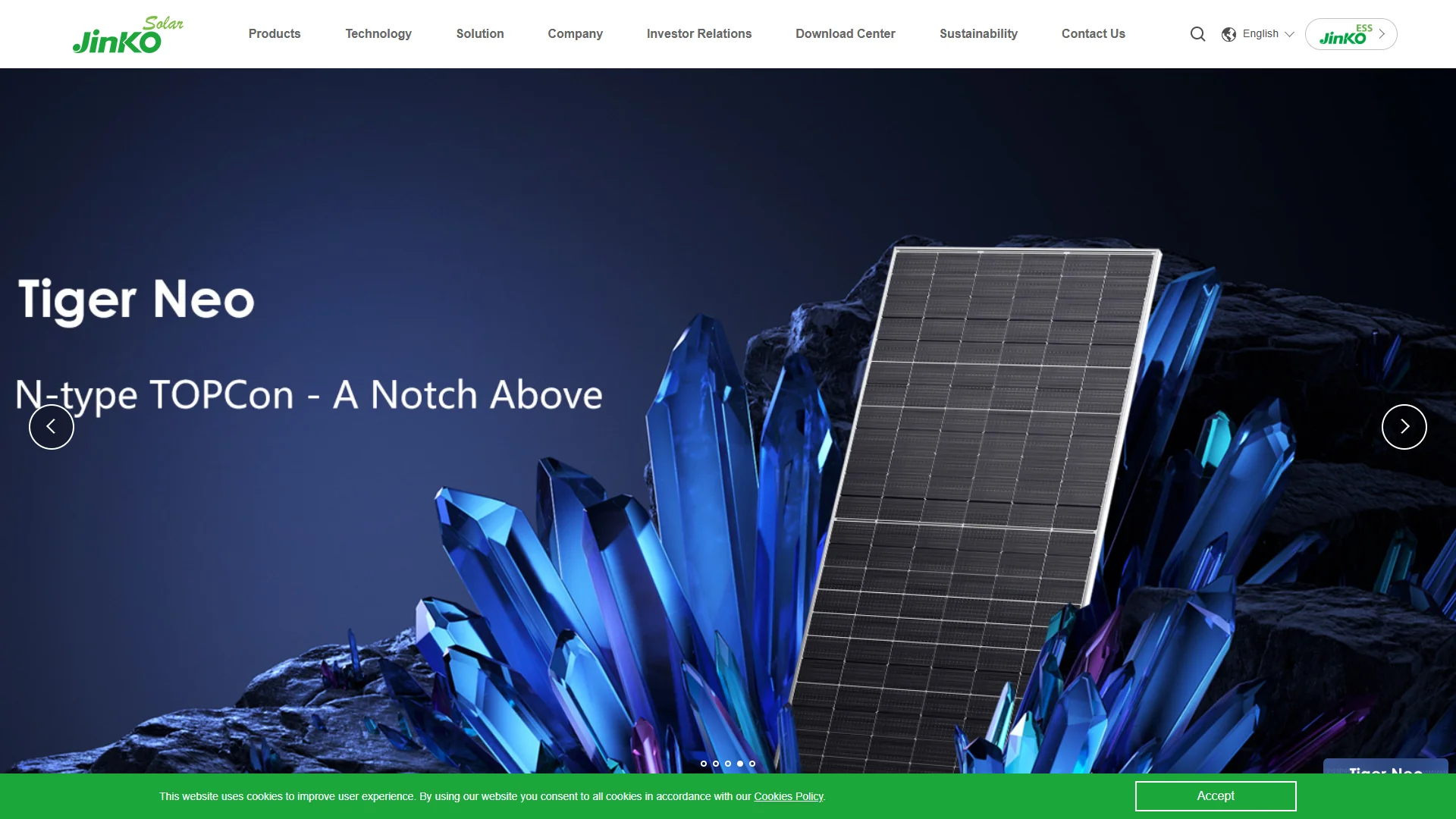
Jinkosolar is a major global solar manufacturer established in China in 2006. The company describes itself as an integrated photovoltaic enterprise covering silicon material, cells, modules, and system solutions. It was listed on the New York Stock Exchange in 2010 and operates a broad international sales, manufacturing, and service network. Its principal N-type offering is the Tiger Neo family, which uses TOPCon cell technology and is presented in versions for residential, commercial, industrial, and utility-scale applications.

Overview
The company’s positioning is based on scale, international distribution, and a wide module range rather than a single niche product. Jinkosolar publishes technical datasheets, installation documentation, warranty information, certifications, and product announcements through its official channels. Buyers can therefore compare module dimensions, electrical characteristics, operating conditions, and warranty terms at the model level instead of relying only on brand-level claims.
Products and Materials
Tiger Neo modules are based on N-type TOPCon technology. Compared with conventional P-type products, N-type cell designs are generally selected for their potential to deliver high efficiency and lower long-term degradation, although the exact result depends on the module model, installation conditions, and warranty terms. Jinkosolar offers different cell and module formats across the Tiger Neo range, including products intended for high-density utility arrays and smaller distributed-generation systems.
The official product documentation should be checked for each procurement lot because power class, dimensions, connector specification, mechanical loading, temperature coefficient, bifaciality, and warranty language vary between generations. This is particularly important when modules are being installed on trackers, high-wind rooftops, or projects with strict inverter and racking compatibility requirements.
Market and Business Scope
Jinkosolar serves residential, commercial, industrial, utility, and off-grid or specialized markets through regional subsidiaries, distributors, and project channels. Its international footprint can be useful for buyers that need documentation, logistics coordination, warranty administration, or technical support across multiple countries. The company also supplies modules for large projects, where bankability, standardized documentation, and production capacity can influence financing and construction schedules.
Pros / Key Features
- Broad N-type TOPCon portfolio under the Tiger Neo family.
- Product choices for residential, commercial, industrial, and utility-scale projects.
- Large international manufacturing, sales, and service presence.
- Public technical datasheets, certifications, installation instructions, and warranty documentation.
- Experience across the wider photovoltaic value chain, including cells and modules.
- Multiple form factors and power classes, allowing system designers to optimize array layout.
Use Cases / Best For
Jinkosolar is best suited to buyers that want a globally established N-type module supplier with a substantial product range. It is a strong fit for utility-scale procurement, commercial and industrial rooftops, multi-country portfolios, and residential projects where the installer requires a recognized brand and accessible technical documentation. Purchasers should still compare the exact Tiger Neo model, delivery location, warranty jurisdiction, approved distributors, and independent quality requirements before signing a supply agreement.
2. Aptos Solar
Aptos Solar is a solar equipment brand serving residential and commercial customers, with a strong emphasis on the North American market. Its public product offering includes the DNA module family and associated solar system products. The company presents its business around module supply, installer relationships, and system-level support rather than the same vertically integrated scale associated with the largest Chinese cell and module groups.

Overview
Aptos Solar is relevant to buyers comparing N-type modules because its product information includes newer high-efficiency module designs and product lines intended for distributed generation. The precise cell architecture and electrical specification should be confirmed in the current datasheet for the selected DNA-series model, as product generations and regional availability can change.
Pros / Key Features
- Residential and commercial product focus.
- Installer and distribution orientation, particularly in North America.
- Product documentation covering module specifications and system compatibility.
- Useful option for projects that value regional channel support and service coordination.
Use Cases / Best For
Aptos Solar is best considered for residential and smaller commercial installations where installer familiarity, distribution availability, and local support are important. Buyers should verify the manufacturing location, exact N-type technology, certification package, warranty issuer, and availability of replacement modules for the project’s market before placing an order.
3. Maysun Solar
Maysun Solar presents itself as a module supplier focused on distributed photovoltaic applications. Its published product range includes N-type TOPCon and other high-efficiency module technologies, with product categories aimed at residential, balcony, and commercial installations. The company provides product information through its international website and serves customers through online sales and regional channels.

Overview
Maysun’s positioning is centered on a broad selection of compact and high-efficiency modules for smaller systems. This can be useful where roof geometry, handling requirements, limited installation space, or relatively low system capacity make large utility-format modules unsuitable. Because Maysun lists more than one cell architecture, buyers should avoid treating all products as interchangeable N-type modules and should confirm whether the selected model is TOPCon, IBC, or another design.
Pros / Key Features
- Offers N-type product lines and other high-efficiency module options.
- Focus on residential, balcony, and distributed-generation use cases.
- Range of module sizes and formats for constrained rooftops.
- Online product documentation that supports initial model comparison.
Use Cases / Best For
Maysun Solar is best for homeowners, small businesses, and installers seeking compact or specialized modules for distributed systems. It may also suit buyers who want to compare TOPCon with other high-efficiency architectures within one supplier’s catalog. Before purchase, purchasers should check local certification, importer responsibility, warranty enforcement, connector compatibility, and the availability of long-term service in the installation country.
4. Tongwei
Tongwei is a large Chinese industrial group with significant activities in polysilicon, photovoltaic cells, and modules. Through its solar business, the company markets N-type module products including the TNC series. Its upstream position in silicon and cell manufacturing gives Tongwei a different competitive profile from brands that primarily concentrate on module sales and downstream project support.
Overview
Tongwei’s solar business is positioned around manufacturing scale and vertical integration. Its module portfolio includes products for large photovoltaic installations, while its upstream capabilities cover important stages of the solar value chain. The exact N-type technology, dimensions, power rating, and warranty conditions depend on the TNC model and production generation, so the current official datasheet should be used during technical evaluation.
Pros / Key Features
- Strong presence in upstream polysilicon and photovoltaic cell manufacturing.
- Large-scale industrial manufacturing capability.
- N-type module products marketed for utility and other large projects.
- Potential value for procurement teams seeking a major integrated solar manufacturer.
Use Cases / Best For
Tongwei is best suited to utility-scale developers, engineering contractors, and large commercial buyers that prioritize manufacturing depth and high-volume supply. It can also be considered for other projects when the selected TNC module is certified for the destination market. Procurement teams should independently assess delivery terms, project references, product availability, warranty support, and the precise bill of materials.
How to Choose N-type Solar Modules
- Confirm the cell technology. Check whether the module uses TOPCon, HJT, IBC, or another N-type architecture. These technologies have different electrical characteristics, manufacturing approaches, and price positions.
- Compare the complete datasheet. Review rated power, efficiency, temperature coefficient, bifaciality, dimensions, weight, operating voltage, current, connector type, and mechanical-load ratings.
- Examine degradation and warranty terms. Separate the product warranty from the performance warranty, then check annual degradation, end-of-term output, exclusions, claim procedures, and the legal entity providing coverage.
- Match the module to the site. Roof area, wind and snow loads, shading, temperature, tracker design, inverter input limits, salt exposure, and fire requirements can affect the suitable model.
- Verify certification and market eligibility. Confirm that the exact model—not merely the brand—is approved for the installation country and complies with applicable electrical, structural, fire, and recycling requirements.
- Assess supplier bankability and logistics. Consider production capacity, delivery history, approved distribution, factory quality controls, independent testing, spare-module planning, and the practical location of after-sales support.
- Compare total installed value. A higher-efficiency module may reduce racking, land, labor, or balance-of-system costs, but its benefit should be calculated against purchase price, transport, installation, and expected energy yield.
Final Verdict
Jinkosolar ranks first among these four options because it combines a broad N-type TOPCon portfolio with substantial international scale, documented products, and coverage across residential, commercial, industrial, and utility markets. Tongwei is a strong alternative for buyers emphasizing upstream manufacturing depth and large-volume procurement. Maysun Solar is more relevant to distributed, compact, and specialized rooftop applications, while Aptos Solar is worth considering where residential or commercial installer support and regional distribution are central requirements. The final choice should be based on the exact module model, verified certification, warranty enforceability, supply terms, and site-specific system economics rather than brand ranking alone.
FAQs
What are N-type solar modules?
N-type solar modules use silicon wafers with an N-type base and may employ cell architectures such as TOPCon, heterojunction, or interdigitated back contact. They are commonly selected for high efficiency and potentially lower degradation, but performance depends on the specific cell and module design.
Is the highest-efficiency module always the best choice?
No. Efficiency matters when roof or land area is limited, but temperature behavior, shading, mechanical loading, warranty conditions, price, installation compatibility, and supplier support can have a greater effect on total project value.
What should buyers request from a Chinese solar module supplier?
Buyers should request the current datasheet, warranty documents, certification reports, factory and quality-control information, approved connector details, delivery terms, serial-number traceability, and a clear process for handling defects or warranty claims in the destination market.